
ALRIC EDRED TIMS (1927 –
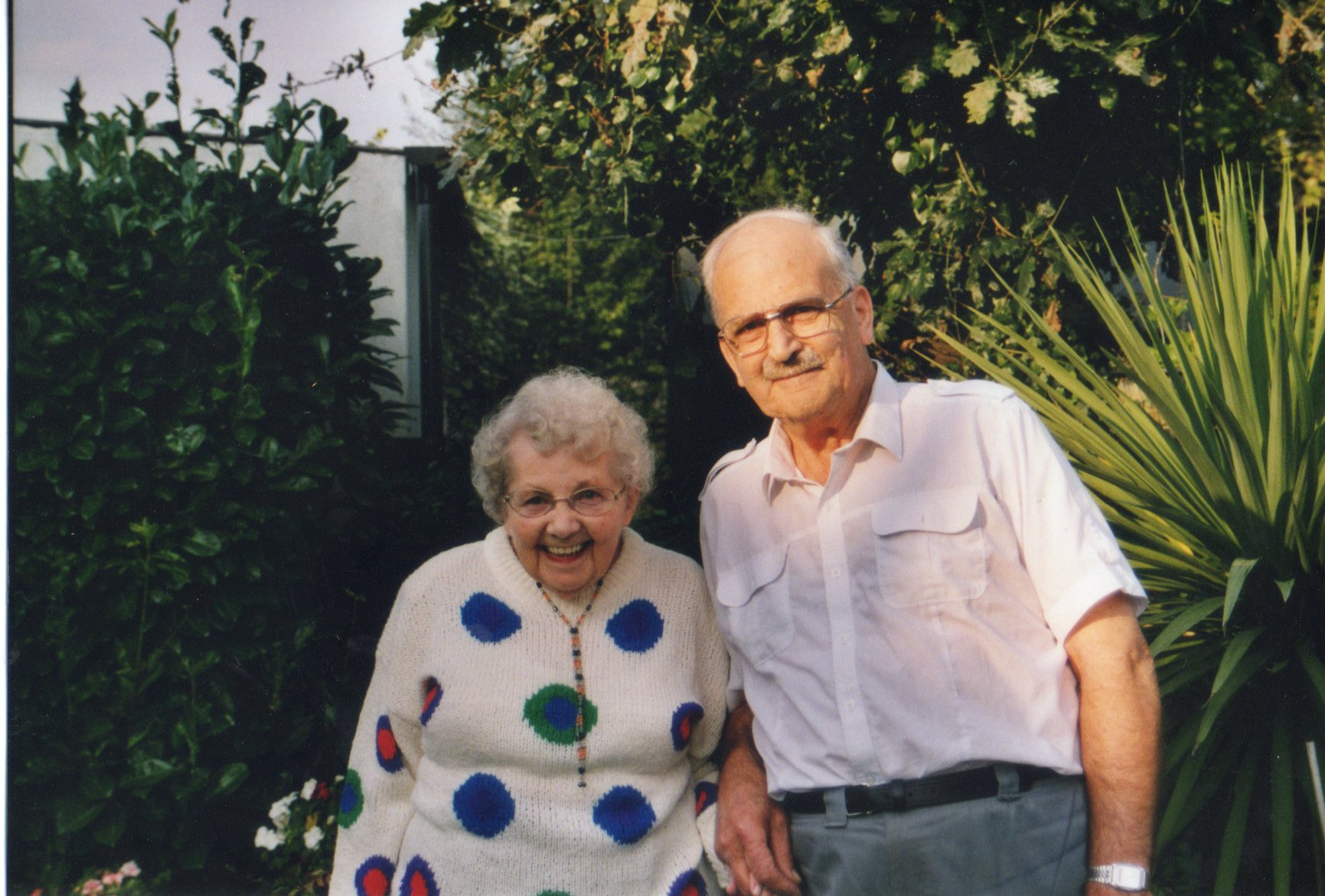
Ed and Moira Tims have lived in Fetcham since 1955 but Ed’s family lived in the area for centuries earlier. His career in agriculture involved a transformation of livestock breeding with international implications. They have seen Fetcham change dramatically during their lives and recall a very much smaller and more open village surrounded by fields.
Interview date: 28 March 2017
Location: Fetcham
Interviewer: Tony Matthews
Early days
[I was born 21 July 1927 in Great Bookham] My first school was Parkside Preparatory School in Horsley and I went to Tiffins in Kingston. But this was just after the outbreak of war and Dad was a bit worried that I had to travel by train, particularly in the dark evenings so he managed to transfer me to the Royal Grammar School in Guildford where I spent many happy years.
Together with my class mates in the sixth form we volunteered as a group to join the forces because there was no escape to go to university. After my career in the army with the Queen’s Regiment I gained a place at Bangor University and studied agriculture. I was there for three years. In the meantime I had met my future wife Moira. She lived only two doors away from us in Horsley.
Career with the Milk Marketing Board
After graduating at Bangor in agriculture and subsidiary subjects, agricultural botany and economics, we got married in 1952. I was seeking a post as a manager or bailiff in an agricultural organisation as I had set my sights on a career in agriculture. But like today jobs were scarce. I went to several interviews with some of the big organisations without success and I finished up by taking a job for practical experience in a farm near Reading.
We spent a year there and then we moved to another farm in Somerset, spending nearly a year there. But we decided – and Dad agreed – that it wasn’t really much of a future and we decided to come back to Horsley. I obtained a post with the Milk Marketing Board. I joined their organisation, not the side actually dealing with the marketing of milk but on the side that dealt with cattle breeding. I worked with Dr Joseph Edwards, Professor Hammond, [Dr Tim] Rowson [and Dr Chris Polge] who were based at Cambridge. I was really only the bottom of the line but I had to put into effect a lot of their recommendations.
Over the years we developed the artificial insemination scheme which meant that nearly all the cattle in this country were bred by artificial insemination. The Milk Board had centres at strategic places in the country where they stationed pedigree bulls and farmers could ring up when they had a cow to be bred and we would arrange for technicians to go along and do the necessary. It grew into a million pound business. From then I graduated to developing the freezing of semen in liquid nitrogen and the transportation of it by air to overseas countries where cattle needed improvement. The injection of sperm from the British bull had an amazing effect in many countries of raising production, style and everything. I stayed in that business for the rest of my working life until I retired at the age of 61 mainly due to the prevalence of the dreaded disease BSE which shut up the markets overseas for the better part of a couple of years.
Local roots for centuries
The family of Tims have been in the area for several hundred years [and] can be traced back to the original harness-makers in Leatherhead in the 1740s. My father’s name was Basil Tims, mother’s Magdalene Eugenie Tims [neé Sims]. Dad came from West Ewell where he was born but mother was a Midlander from Wednesbury in Staffordshire. They bought a bungalow in Bookham on the corner of Groveside and Epsom Road. Dad was a civil servant. He worked in the India Office and later the Commonwealth Relations Office, went out to India on two or three occasions so he was an international traveller in the early days. From Bookham he moved the family to Horsley when I was four years old and it was from Horsley that I started my education at Parkside Preparatory School, the Tiffins and then on to the Royal Grammar School at Guildford.
I have one sister. She married a Canadian soldier who was stationed with the Canadian army in Horsley during the war. She spent most of her life in Canada. That my only sibling. I have no brothers.
[I have] three daughters, six grandchildren and a great grandson. They are scattered. One family lives in York at Stamford Bridge and the other family lives in Cardiff. Wendy lives in Sussex. She is now divorced but she comes to us on a Monday and she is our official carer. She looks after us until Friday evening and then goes back to her little home to look after her son who lives with his father [in the week].
Have any of your children followed in your footsteps career-wise?
No, not really. Two of them have gone to university. Jenny went to Exeter and got an honours degree in geography. She then went into the Forestry Commission where she met her husband. But that was only a short term and then she started her family. She [has] three children now, two daughters and a son. Karen is the brain of the family. She went to Oxford and gained an MA in geography, joined one of the big accountancy firms, Coopers I think it was called [now Price Waterhouse Coopers]. She lived in London for a couple of years and met her husband up there. He came from South Wales and they moved back to South Wales. She gained employment with the Welsh Office and a certain amount of expertise in financing with Welsh Office money of course enterprising jobs that were being set up by young people. After two or three years she decided that this was a career move that she would like to follow so she set up her own company, financing people who are unable to obtain loans from banks or other sources due to past illnesses or disappointments or any particular reason. She is there to lend them a few thousand pounds to start and it has taken off. It is so popular there that she has seen the Member of Parliament about it, she has been interviewed on television and she is now an up and coming business so we feel we have spawned one brainchild anyway.
A home in Fetcham
Having come back from Somerset and decided on a different career we started looking around for a possible house to buy. We had several suggestions but one that came up was inevitably the house we now live in. But when we came to see the property it was no more than a concrete slab. It was part of a small development of a builder who was a foreman of a company but had decided to set up on his own. Anyway he had a good recommendation so we got a building society interested. That was difficult because the building society insisted that the mortgage repayments should not exceed 25% of my salary and there was I just starting up with the Milk Marketing Board and I hadn’t got that level. I had to plead with the establishment officer to put a letter in. He was very co-operative and obviously wrote the right thing because we got the mortgage. The house was built and we occupied it in December 1955. We have lived here ever since. That has clocked up a few years. But after we moved here both of worked at the Milk Marketing Board. My wife joined me for 18 months or two years and then we started a family so she stayed at home and became a mum. I motored from here each morning from Fetcham to Thames Ditton.
What was this area like in 1955 and how has it changed?
Fetcham is divided in half – generously in half – by the railway bank. We feel we live on the north side of Fetcham. There wasn’t really much of us over here. There was just a road called Monks Green which had been pretty fully developed and our little Mole Road which had a few gaps to be filled in. That was all. Next to us was a wide open space which apparently had been an orchard and market garden for a farmer who had lost part of his farm when the railway came through and cut his farm in half. Since then this bare patch of land has developed into a road called Friars Orchard with something like 30 houses in it. Our road turns off River Lane [which] runs down to the river. When we came the numbers of cottages down there were occupied by people associated with the estate for which they were originally built. But as the big Fetcham Park estate broke up these cottages became occupied by ordinary people like us.
Down this end of the village the amount of development was comparatively limited. We border on the river. We’ve got Barracks Farm which is a thriving enterprise, a livestock farm, so it is likely to stay as a farm. But south of the river you’ve got the shopping area. The shopping area when we came was about half the size it is now. We had all the essential stores there, many of which have now gone and been replaced by eating houses, fish and chip shops and things like that. The large council estate was built on what formerly was a farm but the development stopped part of the way to Leatherhead where it peters out into fields which are owned by the Sutton and East Surrey Water Company who have no intention of selling it because they keep it as a reserve in case they need to expand their buildings but also the fact that it sits very comfortably on springs from which they derive a source of water for the locality and for parts of Elmbridge.
The top of the village has changed quite a bit in our time. The house now known as Fetcham Park House was a school. It was owned by a clergyman who came from Suffolk. A small public school and we used to see the boys now and again but it was behind the walls, a private place, didn’t know much about it. But they sold off most of the land which has now been developed into housing estates with expensive housing. No doubt about it. Much more expensive than down our end of the village. But the village then was village of commuters really because in the middle of the day there was hardly anybody about except housewives because everybody went out to work.
Involvement with the community
Once I had settled down to my job in Thames Ditton after a few years and the children growing up I decided I would like to get involved in some community work so I joined the Fetcham Residents Association and became involved in planning matters and the general run of the mill where the village has to stand up and say something and fight for its rights. My wife had joined the women’s club at the church so we had an active social life apart from the working day so therefore my actual presence in the village was limited. Working away from the village during the day, in the evenings perhaps the odd meeting.
I didn’t really appreciate how quickly the gaps in the village were being filled up. Where we had a small field or an open space, all of a sudden we had a lot of houses in it. We had a recreation ground with a woodland by the side of it and it transpired that this woodland had been set aside for the route of a motorway which never materialised but when they built the M25 it took a different route so this area suddenly became redundant and that filled up with houses. So the village, from being a comparatively quiet commuter-based village of something like 2500 people suddenly rocketed over the years to what it is today of nearly 8000.
I wouldn’t say the temperament of the village has changed – I don’t think it is different to any other village. If you want volunteers for a committee you won’t find them in today’s working people. They have to be 50 or 60 plus. Gradually a lot of these groups have disappeared, mainly through lack of support. I stayed with the residents association for 40 years. I did ten years as chairman and 25 years as secretary before that. I still feel part of the village even though I am sitting talking about it.
My involvement with the residents association started with going to a meeting at the village hall when they were discussing road safety for the children. I must have created a bit of a stir because I managed to persuade them to create crossing keepers as they were known then. So the children could cross busy roads with the help of what are now known as lollipop ladies.
What usually happens at these sort of meetings is that somebody stands up and says something profound. They say would you like to join the committee? So I found myself a member of the committee. Not long after that there was an upheaval in the nomination of local councillors which caused most of the existing committee to resign so I was left with the chairman and I said well I’ll stand in as secretary if you like. Well that started a 25-year stint of writing all the correspondence and writing all the minutes for the association. Eventually escalating to the point where I seemed to be the only senior member and I was elected as chairman. I did the last ten years as chairman. It was an interesting job. I met a lot of useful people. It would be rather onerous to even start a list of achievements, corresponding at times with various local affairs. But it was an absorbing job which I gave up about eight years ago.
Countryside protection and the history society
Alongside of that I also had membership of the Leatherhead Countryside Protection Society. This was the result of a link through the History Society. Stephen Fortescue was one of the prime movers of the Countryside Protection Society and at one stage he decided that for it to be comprehensive there ought to be a representative on his committee from each of the villages. So I was nominated by him to serve as the Fetcham representative. I can’t remember how many years I’ve been on the Countryside Protection Society, for the better part of 40 years I suppose.
The link came because I met Stephen Fortescue consulting him as a solicitor and he said: ” I came across your name in the history files the other day. Tims, have you got any relatives in this area?” So I said: “Well yes.” That started it. He then gave me the sheet out of the History Society Proceedings with my family tree on it and we got quite a friendship going on that one.
Well from the Countryside Protection Society the next step was to join the History Society and as I did a lot of work for the Countryside Protection Society – and I still do – my involvement with the History Society [was limited. Although] I wrote part of the History of Fetcham and I have put one or two papers through for the Proceedings and for the Newsletter but it was a matter of time and patience I suppose.
Moira’s early life
My name is Moira Tims. [I was born] 26 March 1926. In 1939 my father’s firm took over Horsley Towers as an office during the war. I was at [a London] school and he wanted me a little bit nearer so I moved to a convent on Effingham Hill. My father remarried and moved to Horsley with his new wife. I left school when I was 16 and went to live with them in Horsley. That was the beginning of my existence here. Edred lived just down the road from me and we were friends for a long time and then he went into the army and I went to work in Guildford. We re-met and married in 1952. In 1954 we decided we would like to find a nice house to live in and we were looking round in this area because it was near both our parents [who now] lived in Horsley. We came across a possible house in Fetcham [and] watched it [grow] almost brick by brick. We came every week to see how far the building had got and eventually when it was [finished], even though the paint was still wet, we moved in 1955 and we have been here ever since.
Fetcham as it used to be
In 1955 our road was just a dirt track. It was a road with no pavements and we were the last house. In our little group there were three houses that were built all together. Behind us and at the side of us it was all open land. There were a few houses that were built in the 1930s and that was it. Friars Orchard was an old orchard with fields and no houses at all. When the children started school we used to walk to school. Nobody took their children to school in a car. We walked there and we walked back.
[To begin with], Edred and I went to work at the Milk Marketing Board but when our family were born I of course was in here all day long. The grocer’s shop used to come round with a little book. You used to write what you wanted in the little book. He used to take it away, get it all together and deliver it and that was fine. He was very glad of your custom, he couldn’t do enough for you. We had a coal merchant that used to come with his sack on his shoulder and shoot coal into a coal shed. What else was different? Oh the shops. We didn’t have nearly so many shops. Monks Green was there and the Hillyfield was there but Hillyfield was just one road. Lots more houses have developed there. The river was delightful in one way. It was all wild and fields. There was no [road] bridge – it was just a wooden bridge and a splash. That was all there was when we came here.
It was all open. There were no Gypsies anywhere. They had not found us. We used to walk along a footpath [by the railway] to Leatherhead. Where the houses are now used to be a pig farm. There used to be a little passageway that went along beside the railway. But you used to have go past all the pigs and we had to do the last bit holding our noses because it was so smelly.
The children could walk there on their own with nobody molesting them and we had no worries at all. The children used to walk to school there and back. Behind our house it was all rough. There was a footpath as such, not a made up one but a rough one. The children used to cut through to school there with no worries whatsoever.
Bringing up the children
There was the village school but not as we know it. They were all in one building, the infants and the older children. They had no kitchens so they all had to cross over to the village hall to have their midday meal. They had nowhere to hang their coats or anything. They had to put their outdoor things on to go across and have their meal. So they used to sit in an overcoat or a mackintosh and we always knew what they had had for dinner because it was all spilt down them. They used to sit on benches, not chairs so anybody that walked behind knocked them…. In 1965 the middle school was built and then things improved. But the little school has grown a lot. It has had [new] buildings on it.
I was involved with the wives’ group and Ed was busy with his things. We used to take the children to the coast or take them to the woods. We used to go to Wales on holiday. We liked the scenery there and it was lovely there then….There was a cinema in Leatherhead of course….I remember going once to take the children to see a children’s film. The only thing I remember about it was my daughter was given a bag of crisps….[by]a lady that used to appear with a tray in front of her and a torch and used to sell things…..My daughter had this bag of crisps and she got all excited about what was going on and she jumped up and forgot that the seat tipped up. She sat on the floor. That’s all I remember about it. Crisps everywhere. That was one of the very few times that we did go to the cinema. We joined in the school activities.
Did you go to church?
Yes…not every Sunday. I did belong to the wives group and we had evenings in the church hall. [One task was fund-raising for the church hall.] Those that volunteered were all given £20 which was quite a lot of money then and we were asked if we could increase that in a month by making things ands selling them or doing odd jobs in the garden for people. Whatever you thought of that could make money. Then you would give it back plus whatever you had made. It was quite an incentive. People said I’ve made so and so. That was quite fun. Pantomimes at the end of the year took a lot of fun in rehearsals which occupied me for a lot of evenings. The children were growing up and they had parties to go to and the years have just rumbled by. Just memories now.
WRITTEN REFLECTIONS ON FETCHAM
By A.E.Tims, March 2017
We bought our house in 1955 at a time when Fetcham was beginning to expand after the war years and there were still traces of the former agricultural village with open spaces and fields for grazing animals and a wealth of wild flowers.
Fetcham Park was still a ‘park’ although The Mount and Ridgeway had taken a large portion for houses. The house itself was called Badingham College and was a private school for boys owned by the Rev J.Wilkie who came from a village in Suffolk after which the school was named.
Large areas of woodland existed on the western fringes of Fetcham with a wide swathe derelict reserved for the South Orbital Motorway which was never built as the M25 outdated the idea. The desperate shortage of housing was reflected in the occupation of the old pig farm (Pound Farm) by squatters eager to find a roof over their head. It would be some time before the LUDC could accommodate them.
The family of Stiles lived in Monks Green Farm although the land had been sold sometime before to a developer who still hopes to build there some day. Some outbuildings remained and Virginia White kept a herd of Jersey cows that were milked in the byre. Each morning she herded them across the Cobham Road to pasture adjoining Barracks Farm. Her parents had been cattle breeders and had shown animals at local shows with some success.
River Lane was partly macadamed but became a rough track leading to the river. A row of cottages on the west side dated back to the days of tied cottages of the estate. One notable resident was Harold Sainsbury who had lived in Fetcham all his life, running a general commodity business – that would be ‘scrap dealer’ in today’s parlance – buying and selling any item that made money. His car scrap yard contained a history of past motoring. He was very popular in the village and could turn his hand to most tasks including building, gardening and assisting local events by providing tenting and open air cooking.! His father, Frederick, had, some years ago, purchased a part of a field for £75 on which he built the first houses in Mole Road, before the war.
Some pre-war housing lay on the east side of River Lane but the most significant estate was Friars Orchard which had been part of Pound Farm where vegetables and fruit were grown. We knew it as a cleared space ready for development. The builder was Frederick Oak who had completed Mole Road prior to starting on Friars Orchard. We first saw our house as a concrete slab waiting for the bricks.
River Lane ended at The Splash – a ford where horse-drawn vehicles could cross in the shallows and a timber footbridge that enabled foot crossing to the island and to a more substantial bridge over the main channel. The island, owned by Barracks Farm, was a wilderness of scrub and brambles and it would be some years before it would be cleared to provide a recreational area for the public. I was responsible for it to be leased to the Leatherhead & District Countryside Protection Society who now maintain the land.
The core of the village comprised a group of shops at the southeast end of Cobham Road. We remember the post office with Mr and Mrs Bartlett in charge, a chemist, greengrocer, grocer and a butcher. On the opposite side of the road were further shops that include Nunn Bros (ironmonger) with the popular Tom Nunn in charge, a radio and TV shop, confectioner and launderette. Further shops were located at the north end – a grocer, hairdresser and cycle and repair shop.
Tudor Motors dominated the centre of the village. Owned by the popular Ernie Tinney, he had brought his business from Boxhill and, succeeded by his two sons, operated there for over 50 years
Between the shops a vacant ‘green’ (originally owned by some brewery for a possible public house) became the venue of local events until the present supermarket occupied the site.
THE MOLE & OLDMILL STREAM
Every spell of wet weather raises the spectre of flooding somewhere in the village of Fetcham. (This note is to assemble the known and the predictable facts about the stream that is the major carrier of surface water to the River Mole.)
GEOLOGY: The Fetcham springs result from deep aquifers in the underlying chalk beds that form part of the strata of chalk that fringes the south side of the Lower Road. The geological map of the area illustrates this and the bordering clay beds on the north side of the road. It is these clay beds that act as a barrier to free drainage and where they join the chalk there is the emergence of springs.
It is these clay beds, [which] are largely impervious, that cause the spring line that affects the village from the foot of Hawks Hill in a roughly straight line through the rear gardens of Cobham Road (south side), The Ballands North, School Lane and Oakfield School. The presence of spring water close to the surface, is illustrated by the lake in The Ballands, the need of a surface water drain in the gardens of School Lane and the wells in the school (formerly a supply to the kitchen of the old headmaster’s house, removed nearly 100 years ago). [Other illustrations include] the Well House, the Salt Box and a sporadic flow from the school fields. [This] became a problem in years past as the flow across the road posed a hazard for vehicles. There was a pond on the corner of Bell Lane and Lower Road, fed by this flow [which] has now been filled and built upon.
The effects of the spring water have been largely controlled by drainage through Cannon Grove, the sewer installed by Leatherhead Urban District Council in School Lane and Town Path [which connects Pound Crescent with Mole Road.] The Sutton and East Surrey Water Company has harnessed the output from the deep springs by capping them, pumping the water to storage on Hawks Hill (Elmer Treatment works) and supplying the locality and some areas in the Elmbridge District.
TERRAIN: Prior to the mid 19th century, the River Mole overflowed several times, according to records dating back to 1873 and caused minor flooding on the flood plain. This did not cause a major problem as there were fields to the south of Leatherhead (e.g.Thorncroft) and north of Fetcham capable of relieving the pressure. The problem began with the coming of the railway and the need to cross the River Mole between the town and Fetcham with an embankment.
The engineers of that era decided to alter the course of the river on a length that included a horseshoe bend, thereby creating a straight section for the railway. The former course of the river can be traced on the Ordnance Survey Map of 1965 (grid ref:TQ1456) where the annotation COCR clearly marks the former course of the river.
Clearly, the building of housing estates on the now excluded river bed was unwise and subsequent history illustrates that, when in spate, the River Mole reverts to its former course and inundates any building in its path. In defence of the railway company, they did predict that this could occur and, where there existed a right of way, they built accommodation bridges (Cannon Court and Town Path) for pedestrian and agricultural purposes. Between these bridges they inserted brick-built culverts through the embankment to facilitate the drainage of water through what was now a barrier. Sadly, these culverts have been allowed to deteriorate and serve no useful purpose.
OLDMILL STREAM: The Oldmill stream rises near the Bookham Ponds, east of the village, and flows through drains to make a brief appearance alongside the Cock Lane Recreation Ground after being fed the surface water from the developments east and west of The Glade. It is now flowing on the impervious clay level including the Copperfields estate, formerly woodland scrub, reserved for a motorway that was never built.
At Cock Lane it enters a large bore pipe that takes it underneath the retail shops, the Cobham Road and the housing that forms part of Shamrock Close. The railway company was probably faced with the prospect of a stream flowing over an existing road, possibly a ford or splash. At the time it was bridging rights of way it may have decided to pipe the stream under the road, thereby leaving free passage of vehicles under a bridge we now see at the head of River Lane.
Taking the stream under the railway bank was by a culvert similar to those that are now defunct. The stream now flows through a brick-built tunnel emerging at the end of Friars Orchard. The subsequent route was determined by a former field boundary (part of Pound Farm) and traceable by the veteran oak trees that would have separated Cannon Court Farm from Pound Farm. The marker oak tree is estimated to be 250 years old.
The stream takes most of the surface water from the village centre, although it was necessary to install a supplementary drain with a large bore to take the extra flow, routed under the railway bridge, the verges of River Lane to discharge into the river near the footbridge. Some further land drains which would have taken the surplus water were identified by the local authority using remote controlled TV cameras. These found them blocked by foundations of Pound Crescent housing.
The potential is for the Oldmill Stream to overflow on its emergence at the Friars Orchard exit but its normal flow is moderate (sometimes nil in summer). Properties at the end of Mole Road would be vulnerable.
The principal cause of major flooding in this area has been when the River Mole bursts its banks at Leatherhead and flowing across the old river bed and through the accommodation arches. The most vulnerable properties are in Cannon Grove, Raymead Close, Cannon Way, parts of Pound Crescent and Mole Road. Any housing built on the flood plain of the River Mole must be considered vulnerable at times of heavy rainfall. This could be a summer thunderstorm.
References: British Geological Survey Sheet 286 REIGATE
Ordnance Survey 1965 England & Wales
Additional Note: The name Oldmill is taken from the annotation on the OS map showing a mill on the River Mole at Oldmill Bridge. It is where the Oldmill Stream joins the river.
Additional Note: Many properties discharge rainwater from guttering etc directly into the foul sewer. During heavy rainstorms the volume of this mixed effluent is increased by as much as 40% and a tank sewer was installed in 1990 alongside Town Path to temper the flow into the system at the River Lane Pumping Station (Thames Water)