
CONSTANCE ALLAN
(1911- 1997)
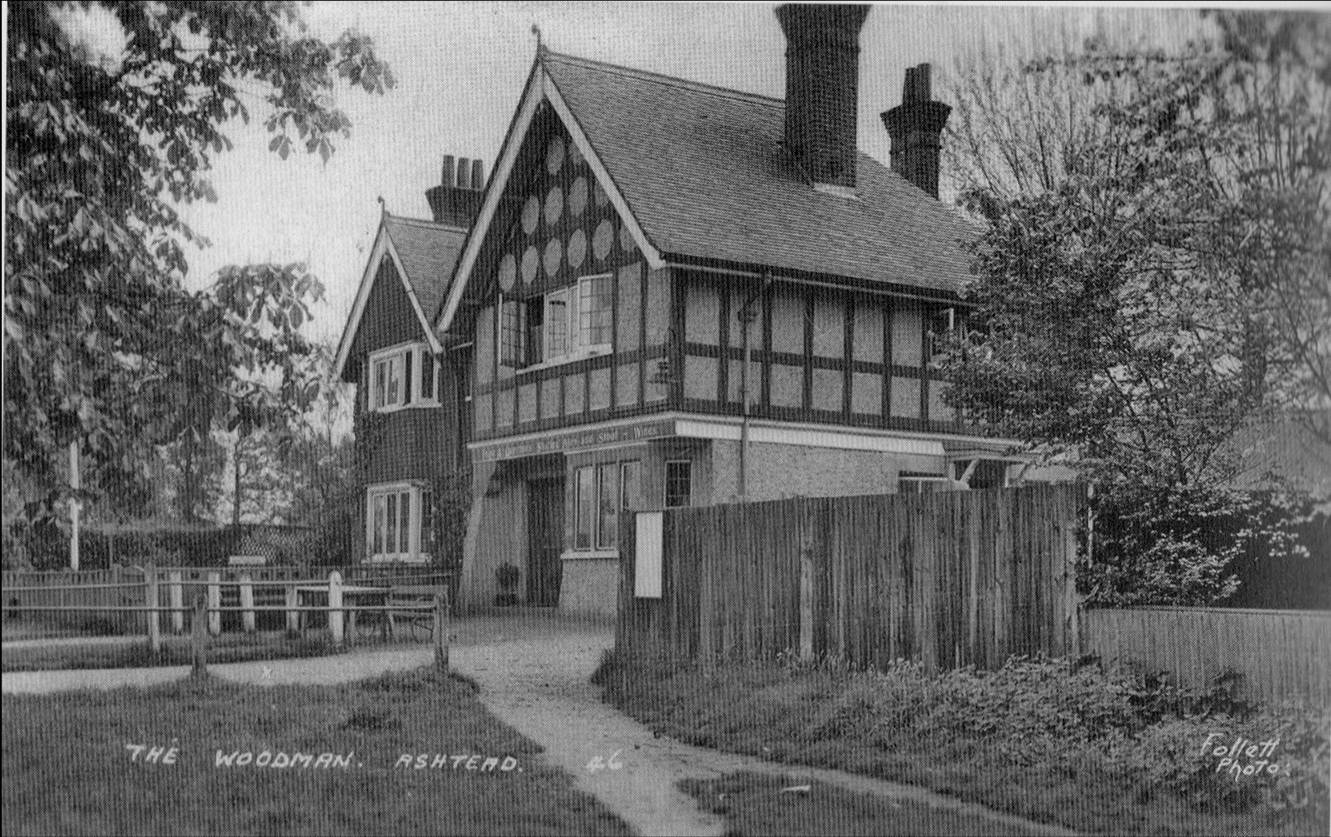
Constance Allan was part of the family that ran The Woodman pub in Ashtead from 1912 until the mid 1950s and several other pubs across the south-east. They lived and worked on the premises, employing staff and serving the local community right through two world wars and beyond. Twice married, both of her husbands had tragic ends.
Interview date: 6 December 1991
Venue: The Midday Sun, Oak Terrace, Ashtead
Interviewer: Edwina Vardey
Family origins
EV: You came to Ashtead from Brixton when you were six months old. (She was born 15 July 1911 in Brixton.) Your father was a publican.Constance Allan: That’s right, a licensee. Henry Frank Sammé, known really as Frank.
EV: He was married to Annie Clints from Shropshire.
Constance Allan: No she originally came from London as well. Stockwell.
EV: You thought it was French.
Constance Allan: Yes but according to my nephew, he found out that it was a Yorkshire name. He got it through a grapevine where you tried to get your ancestors. I had two brothers and one sister but my mother lost two daughters. One at childbirth and the other one when she was vaccinated. So she had six altogether. All worked in the pub. The boys used to drive the cars later in life.
EV: You don’t remember the pub in Brixton but then you came to The Woodman. (The Woodman, Ashtead, Barnett Wood Lane, Surrey KT21 2DA)
Constance Allan: That’s right in 1912.
Successive buildings
EV: It was a cottage.
Constance Allan: That’s right but I didn’t go to that one, I went to the second Woodman.
EV: Has there been another one since then?
Constance Allan: Yes there has. It was built in 1938. I was still there and my father and mother and my brothers and my sister, we all worked with the family. A family pub it was.
EV: Were there many other pubs in the area?
Constance Allan: No, just the Leg of Mutton and the brewery up in the village. We were in Lower Ashtead.
EV: The brewery belonged to whom?
Constance Allan: It originated from Page & Overtons in Croydon and then it changed over to Charringtons. The brewery was opposite the Leg of Mutton in the High Street.
Livestock and wood collection
EV: Your father did lots of things as well as being a publican.
Constance Allan: Yes he did. He had pigs, which the local butcher, Mr Page – the butcher’s shop was in Ashtead village – and he used to come down and kill the pigs. And we had chickens, ducks, geese and four cows we had. We used to have the milk for our personal use. Four cows – three Jerseys and they all had names. The mother was called Daisy and the calves were Winnie and Connie and the odd one was Brenda.
EV: Where did the cows graze?
Constance Allan: On Ashtead Common. We had a cowman to look after them so they didn’t stray. He used to come every day and feed them and milk them and let them out to graze.
EV: The grazing rights came with the pub.
Constance Allan: That’s right, yes they did. The grazing rights on the Common.
EV: He had other rights.
Constance Allan: Up at Ashtead Woods to get bracken or any woods, any logs and things like that. We had a nice big log fire in both the pubs.
EV: Did you go to help get the wood?
Constance Allan: My brothers did. I had a sister, 14 months old than me, that’s all. I was the youngest.
Happy childhood
EV: What were your brothers’ names?
Constance Allan: One was Leslie Frank and [the other] Geoffrey Percy.
EV: Did they become publicans?
Constance Allan: Just Geoffrey but Leslie stayed on with my father till he retired.
EV: Where’s Geoffrey?
Constance Allan: He had a pub at Epsom. The Plough and Harrow at East Street, Epsom. He’s dead, my brother Leslie is gone and my sister died three years ago.
EV: A happy childhood?
Constance Allan: Very happy, yes. We always had our holidays, mostly in Shropshire. We had an uncle had a farm there and we had some happy days there with animals and horse riding, you know. We were very comfortable. My brothers and sister went to Dorking High School and I was at the Ashtead Council School. I finished there, I never went to the high school.
Visitors from London
EV: You helped in the pub for a living.
Constance Allan: Yes, we used to do teas in the garden and we had all the poorer children from London used to come and have their teas. There was about a thousand at a time. We used to do all their teas in the pavilion at the back and if it was a nice day they would go on the lawn.
EV: How did the poorer children come? By coach?
Constance Allan: No, by train. Special trains they used to have.
EV: A charity outing?
Constance Allan: Yes and also the Deptford flower sellers. They were some characters. All jolly people they were. Over the line they also did teas there. They went in the corner – where there’s houses there now – and they used to have swings and roundabouts for the children.
EV: In the 1930s.
Constance Allan: Before the war, yes.
Wartimes
EV: Can you remember the First World War?
Constance Allan: No, my only knowledge of that was when I went to the school along here, they had a soup kitchen. I think it was for the soldiers or the prisoners of war, something like that. We had German prisoners in the recreation ground but it wasn’t a recreation ground in those days. It was the coal merchants, Mr Chitty used to keep his horses there. Because the coal merchants was all drawn by horses in those days. There were three horses. I always remember my sister and I used to go out there feeding them because it was quite near, next door to the pub, next door to The Woodman.
EV: The German prisoners were under canvas.
Constance Allan: Yes, that’s right.
EV: Your father didn’t have to go to war.
Constance Allan: No he didn’t. He did work in a munitions factory for a while and my mother kept on with the pub with helpers, part-time staff.
EV: Where was the munitions factory?
Constance Allan: That was at Bookham.
EV: Down by the railway station.
Constance Allan: Yes, that’s right.
Pub community and licensing
EV: Your father had friends among the other publicans.
Constance Allan: Rose and Crown. We used to go there every other Sunday and have our tea because the pub used to close at two o’clock and not open again until seven so we had that time for tea and games and social events amongst the families.
EV: Your mother worked all the time.
Constance Allan: Yes she did.
EV: Were there licensing hours?
Constance Allan: Yes we used to open at 11 o’clock until half past two and again at half past five until ten o’clock in those days. Quite long hours and on Sunday it was 12 o’clock until two and seven o’clock until ten. Christmas Eve we used to have an extension until 11 o’clock. New Year’s Eve was an extension until 12 o’clock.
EV: As children you weren’t allowed into the pub.
Constance Allan: I wasn’t allowed until I was about 15, that was all. I used to do the odd bits you know. We used to do snacks and that and I did the washing up and things like that. I was in the kitchen.
Catering for the community
EV: Did your mother bake all those teas and things?
Constance Allan: No, I’ve forgotten where she got the bread from now. But it was a full-time job buttering all the sandwiches and they used to have… when we did the teas – not for the children – but when we did the teas other than the parties we had they used to have the produce from the garden. Like tomatoes and lettuce with their teas. The menu was bread and butter, lettuce, tomato and jam and a pot of tea. We always had pots of tea and I used to do the waiting….and it wasn’t easy going. Working on a lawn, it was really hard work working on a lawn because it wasn’t sort of level, not level enough for me. The pathway wasn’t a cement path like that it was gravel paths, quite hard on your feet really. We used to boil the water up in a big copper and when we washed up we used to have an old sink and all the water used to go down the ditch. The water went down the pipe of a motor tyre, the inner tube. We had no drainage, nothing like that. That was done in the pavilion, not in the house. Everything was done from the pavilion. Boiling up the tea as well. We used to have a copper there.
EV: Is the pavilion still there?
Constance Allan: No, not now. It’s all modernised now. Now they’ve the third Woodman at the back there.
EV: Your father understood about beers and kegs.
Constance Allan: Yes he did. The pipes were cleaned out every day, they used to be pumped out with hot water for cleanliness, all the beer pipes. We had the old fashioned barrels of course. They had a cistern in and the cistern had to be kept tight.
I remember the Swan, yes as a pub. We went down a bit of a slope to it. I don’t remember an awful lot because I never travelled very far really because we were working most of the time at the pub.
Family pubs and travelling to school
EV: Did your parents have a hard life?
Constance Allan: Well I suppose what it was, because my father’s people were also in the trade, his father had the Blue Anchor at Tadworth, that was my grandfather. It was transferred to my aunty when my grandfather retired. My aunty took over, Mrs Jarvis. She’s dead now and her husband is dead as well. They renewed that pub as well. Still called the Blue Anchor.
EV: Your mother, her family, had a steam laundry and a pub.
Constance Allan: A steam laundry and a pub, that’s right.
EV: What was her pub called in London?
Constance Allan: The Live and Let Live I think it was. Then my father was transferred to another one, the Perseverance at Brixton. One was Stockwell, I think and one was the Perseverance. That was where I was born. The Perseverance at Brixton.
EV: You left school at 13.
Constance Allan: No I stayed on till 14. I used to work when I was 14. I used to help, washing up and do little odd jobs. Just had to cross the road for school, that was all. Mother used to drive my brothers to Dorking High School with a pony and trap. There weren’t any trains in those days, not to Dorking. She used to get frostbite in the fingers. All through the cold weather she used to take them every morning, leave them and fetch them in the afternoon. Took a long time.
EV: Half an hour or more.
Constance Allan: Must have been more because there weren’t any motorways in those days.
EV: How would she have gone? Over the Downs?
Constance Allan: Boxhill way, used to go that way. Just one pony. Dolly her name was.
EV: You went to Bookham in the pony and trap on Sundays.
Constance Allan: Yes, that’s right. We did. Later in life my father used to take us in the car.
Car hire business and the duck pond
EV: Your father had a car hire [business].
Constance Allan: Yes, my brothers used to drive and my father used to drive. We had three cars.
EV: A taxi service?
Constance Allan: Yes it was. They were all his own cars. He had two Dodge cars and one Ford. They were kept in the garage at the back there and the beer used to be in the sheds. Two and half acres we had. The top part, later in life, we let it out for allotments. Most of the people who lived in Oakfield Road. They had the allotments because they had access with their fences and get through to it. We had campers as well in the orchard. We had apple trees and pear trees there. And we had the duck pond that was also attached to the ditch. The ditch used to run down there and used to go round there to the duck pond and back that end to the other to meet down the side of the ditch for the ducks. They always had water in their pond cause it came from the ditch. My father’s ducks they were.
EV: Did you have duck at Christmas?
Constance Allan: No the only ones we had were the chickens. We didn’t have those at Christmas, we had turkey. If we didn’t have turkey we had geese. We used to have six geese. They were watchdogs because if anybody went near they used to make awful noises. They were a sort of guard dog.
EV: Did you have dogs?
Constance Allan: Yes, we had three dogs – we had a terrier, a spaniel and a collie, a Welsh collie.
EV: Your parents lived to a ripe old age.
Constance Allan: Yes, he didn’t really retire until he was 70. He wasn’t very happy, I’m afraid. He used to listen to the wireless and cross his legs a lot and in the end his mind went. After he had gone, my sister and I used to look after my mother. She used to have her meals here and go back to their cottage at Epsom.
Husbands and children
EV: Where did you meet Mr Allan.
Constance Allan: I met him in the pub, in The Woodman.
EV: He was a customer?
Constance Allan: He was my second husband.
EV: Who was the first?
Constance Allan: Taylor. He was a builder’s son. Taylor of Epsom.
EV: You met him in the pub too?
Constance Allan: Yes. That’s right.
EV: Did Mr Taylor die?
Constance Allan: Yes. He took his life, I’m afraid, in Ashtead Woods. It was six months before they found him.
EV: Did you have any children?
Constance Allan: Daughter and a son. I lost my son four years ago. My daughter’s my one and only now. (She married Arthur Harry TAYLOR in the September quarter of 1932 in Epsom. He was born 20 September 1909 in Epsom and died in the December quarter of 1951 in Surrey Mid Eastern.)
EV: How old was your daughter when your husband died?
Constance Allan: Nine I think it was, yes.
EV: Then you met Mr Allan.
Constance Allan: Yes much later. I met him in 1952 – was it coronation time, 1953? We married in 1955. Always lived in this house, yes.
EV: Is Mr Allan alive?
Constance Allan: No, he died in August this year. He fell down the stairs and died instantly fixing a curtain. He was terribly afraid of burglars and never liked the curtains drawn back like this. They always had to be drawn so that nobody looked in. He had a terrible fear of burglars all the time. Even in the garage he used to cover all his tools up with bin bags. He was so afraid that burglars were going to take his tools, take anything. He was fixing the curtains up at the top of the stairs and he must have lost his balance. I was in here watching the TV and he died instantly. I had the ambulance-men but they couldn’t revive him. I’ve got my daughter living with me now thank God. She’s taking care of me and we’ve got three grandsons and a grand-daughter. They are all in their twenties. (She married William ALLAN in the June quarter of 1955 in Epsom. He was born 25 July 1905 and died in the September quarter of 1991 in Surrey Mid Eastern.)
EV: Your son’s name was Ray.
Constance Allan: Raymond yes. He used to help in the pub. My daughter [Jacqueline] used to help in The Woodman pub too. Used to lay the tables out for weddings or funerals. Help with any parties and that. She was a great help. She used to get her first wages she bought a doll.
Domestic arrangements
EV: You used to get paid working for your father.
Constance Allan: Yes but unfortunately we didn’t pay the stamps so I’ve just got a basic pension. The only one that had that was my eldest brother. He was the only one that had stamps, not any of us.
EV: Your eldest brother always worked in the pub. My second brother had his own pub.
Constance Allan: Yes he worked there till he got married and then he had a pub. He had a little bungalow in Harriots Lane. Then during the war they used to live at The Woodman and my nephew used to sleep in the cellar. My brother and his wife used to sleep in the cellar as well but where the spirits were kept, in the cage. Locked up. That was the reason that The Woodman was built because it hadn’t got an underground cellar. The old Woodman, the second one hadn’t got an underground cellar so that was rebuilt.
EV: Did Mr Taylor build this house?
Constance Allan: No Mr Crouch, I think from Cheam he came from. All the other houses, just six houses, were left and they were people to buy so we were the first of the six to buy the house.
EV: When did you come to this house?
Constance Allan: 1937.
EV: You had a lot of bombing in Ashtead [during the war]?
Constance Allan: Yes we did. We also had two chain bombs at the bottom of the garden. Next door’s apple trees went up like that and also an oak tree two doors away. That come down but the apple trees next door were replanted again.
EV: Your father was at the The Woodman during the war and he retired in ….
Constance Allan: 1955 was it? Yes, that’s when I married my second husband.
EV: Did you have the wedding reception in The Woodman?
Constance Allan: Yes.
Epsom bakery
EV: Are there still any publicans in the family?
Constance Allan: No they are all dead now. My father’s brother had one at Godalming. He had another brother at Ripley. He had another brother at Down in Kent and his sister was at the Blue Anchor at Tadworth. His other sister was [with] Sheath the bakery at Epsom. A master baker he was there…. The old bakery was called the Old Bakery in Ashtead. That’s where he originated from, Mr Sheath. His father used to bake the bread there and as he got older he used to bake it as well and then he moved to Epsom and baked his bread in Epsom High Street near the Clocktower. A little tiny shop there. A very old worldy shop as big as this the front window. Shop just big enough to sell the bread, that’s all…. Now and again when my father used to go to Epsom once a week to bank and he used to get the bread then, all nice and hot.
Violence in the pub
EV: Did you have trouble at the pub?
Constance Allan: We had one very bad fight and that was a Lancashire man, a big fellow he was. They were repairing the roads and they had subcontractors there. He had too much to drink and he started a fight with another customer and my brothers went to separate them. My youngest brother was hit in the eye and he eventually had to go to Moorfields Hospital and have his eye seen to. There was blood all over the floor. They were floorboards in those days, not carpets. But that was the only really bad fight we had. It was generally really nicely run really. Whenever there were any arguments my father used to say: “Settle your arguments outside, not in here.” He was very strict that way.
EV: Did you have sawdust on the floor?
Constance Allan: Yes we did and spitoons, horrible things.
EV: You used to empty them?
Constance Allan: No not me. We used to have a barman for the public bar but never in the saloon. It was the family who were in the saloon although I always used to work in the public bar. I didn’t like the saloon. The public bar they were so chatty and so friendly and so sincere and caring.
Familiar customers
EV: Did people from the big houses come to the pub?
Constance Allan: Yes they did on the way back from town. There was one in particular, Mr Cummings, he was a jeweller. That was where my wedding ring and engagement ring came from. We were very friendly with his wife as well. I went to his house with my second husband and we were engaged at his house….There was another one who was a very good customer, Henry the newsagents in Craddocks Avenue. He was a very good customer. He used to come in for a champagne breakfast he used to call it. As soon as the pub was open he used to be there at 11 o’clock. He used to have a bottle of champagne to sort of sober him up I suppose. Not every day but occasionally. His friend Mr Browning used to make all the steel plates like door-knockers, those sort of things he used to make as well as tools. At the back of the shops in Craddocks Avenue that was.
Mervyn Matthews was another good customer. He lived in Agates Lane. He was in the printing world….and Mr Nash from the garage. He was a very good customer. He used to have a lunch there as well. He was my special customer. I used to do a special sandwich for him. [At] the second Woodman there was a dining room. We used to serve lunches there. We had a special room for serving up. There were two kitchens but it was arranged all wrong really. They had the kitchen part where the sinks were. They had two big sinks – one big sink for washing up (three big sinks) – and two white porcelain ones for washing vegetables and all that. You would go through a door and that’s where you would do the cooking. It was parquet floor in there [where] we would do the cooking and tiles were in the kitchen. Used to have a stable door which led out to the patio and a lawn at the back as well.
World War 2
During the war we used to have a piano and Frank Low and we used to have singing, that was during the war. He used to play it and have singsongs on a Saturday night and sometimes during the week. Also we had evacuees down from London and they had lessons in the dining room. There was an Ashtead man was a teacher there, Mr Leach, he was a teacher. During the day but the dining room was never used very much during the war…. We used to have the Canadians come there and I’m afraid they done a lot of damage. We used to have seats there, all real hide, and they used to go like that and slit it. My father used to put one chair up and say: “See the damage you’ve done.” Also we had a chandelier and when they had had too much to drink they tried to swing on. They pulled it down. That was the only trouble we had, when the Canadians came. They were billeted up in the Ashtead Woods a big house up there. A big fur dealer.
Suppliers and the butcher
EV: Did you father do all the book work himself?
Constance Allan: He used to leave the book work to me when I got older.
EV: What about getting in all the supplies?
Constance Allan: My mother used to [use] Kinghams of Dorking. Used to get our wholesale food from them. We used to have tea coming in a big box container about that high and about that wide and the sugar, that used to come in big containers too. The soups and things like that used to come in big seven-pound tins and the jams as well. We didn’t make it. My brother’s wife at the Epsom pub, she used to make a soup a day and hot sausages she was well known for. Especially the soups, she used to make home-made soup. My brother used to cook pigs’ trotters at his pub. I used to get very fond of the pigs. My brother used to cook up the pig food in the proper copper. Used to get all the pealings from the potatoes, cabbage and all the vegetables. Used to light up the copper and all had hot food and meal with it. Used to mix up in buckets and give it to them. We had about ten pigs altogether. We had three sties and they had the little piglets as well. It was lovely.
EV: Did you use the pork in the pub?
Constance Allan: Yes my father used to have the joints. They were already cut up by the butcher.
Mr Allan’s career
EV: Mr Allan didn’t work [at the pub]?
Constance Allan: No, he was an inspector, aircraft inspector at Bookham. From there, from Bookham, he used to go to Godalming. Now the Bookham factory, all it does now is knitting machines I believe. They don’t do any aircraft. The aircraft is done at Farncombe, near Godalming now. He received a watch for his services of 26 years.
Remembering The Woodman
Constance Allan: At The Woodman we used to have a gardener, two gardeners as a matter of fact. One used to attend all the roses and the lawn and we used to have fruit as well and we used to sell apples from the trees and pears. I used to help weigh them up as well. Little Hazel pears they were and William pears. And Coxes, oranges and Bramley apples we used to have.
EV: Is the orchard still there?
Constance Allan: I don’t know. They have made the lawns where the pigs were into a car park now. Somebody said the pig stys were still there but I don’t think so but you can see it goes the whole length of the recreation ground, the garden does. I don’t know what’s there now as I have only been there about three times since it’s been rebuilt. It’s not home to me now. The second one was home to me really. It was a bit too big, the other one was. They had lovely rooms there. They had five bedrooms there but just one bathroom, that was all. They didn’t have residents there, not at all.
EV: Did you have residents when your father was there?
Constance Allan: No. Not at all. Our bedroom used to face the church and the boys were in the front. We used to like the church bells going. Used to have all the choir people coming for their drink. After church they used to come in for a drink. We had one maid from Austria. During the war she had a curfew. She had to be in by ten o’clock.
EV: Because she was….
Constance Allan: Foreign.
EV: You keep in touch with her.
Constance Allan: Yes I do. Every Christmas time. And the Spanish lady we had. She was lovely. Spanish dancing and she knitted me – or crocheted me – a lovely shawl.
EV: Spanish dancing in the pub?
Constance Allan: No she used to do that for the family. She used to work in the kitchen. She used to feed the sparrows because apparently in Spain they eat sparrows. She used to love the sparrows and used to talk to them and feed them as well.
Working hours at the pub
EV: You had quite a lot of staff.
Constance Allan: Yes we did. We used to have two pot-men in the second pub. One for the public bar and the other one used to do outside. Two bars and we had a cleaner as well for the kitchen work. We used to have two cleaners for the pub and we had a barman as well. He was in the public bar during the day. We used to get a rush from one o’clock until two o’clock. Before one really, about 12 o’clock. My mother used to get a bit [cross] with my father because he never used to come in to his dinner until he closed. We all had our dinners sharp at 12 o’clock. Only half an hour for dinner, that was all. I used to go first, then my sister, and after her my brother. But he was privileged, he had an hour for dinner because he had to go over to near Ashtead Station. He used to go home for lunch to his wife.
My grandfather used to make novelties. He used to go to the rubbish dump and get all the polish tins and things like that and he used to make toys out of it. Also he used to make cut-out flowers for the garden, paint them, pansies and roses and things like that. Used to decorate his garden with them. He also made a weather vane – all in tin – with a man like that working, sawing wood. I think my brother had those and they were passed on to my nephew.
EV: That must be over 100 years ago.
Constance Allan: Yes must have been. The brewers wanted me, after my father retired, they wanted me to carry on The Woodman but no, I had had enough of pub life and wanted a private life. I’m a home-loving person and although I enjoyed the pub life I still like my home best.
Irish whiskey
EV: Did your mother miss the pub do you think when they retired?
Constance Allan: I think my father missed it more. He was a very popular man, he was. As he got older he used to sit up in the corner and he used to drink Irish whiskey. Customers used to say why are you drinking Irish whiskey and he would say: I’m the only one who drinks it. I can’t sell it. Everybody wants whisky but not Irish whiskey. He used to sit there with his paper, pick out the winners, and my mother, she always used to ring the bell at closing time. That was her job. There goes Mrs Allan, She’s on the bell again, he used to say.
EV: Your father’s name was?
Constance Allan: It was really Henry but he was only known as Frank. That was his pet name.
EV: Where did he live when he retired?
Constance Allan: Epsom in a little cottage near where my brother’s pub was.
Constance Olive Allan died in the December quarter of 1997 in Mid Surrey.